American Eagle Flight 5342 Families are Entitled to Sue the US Military for the Black Hawk’s role in causing the Mid-Air Collision

The Feres Doctrine protects the military from lawsuits brought against it by Families of service members killed in the line of duty as a result of its negligence. The Feres Doctrine does not, however, prevent civilians who have lost love ones from suing.

Families must still navigate the nuances of the Federal Tort Claims Act. The Federal Claims act is the the statute that allows civilians to sue the federal government notwithstanding the doctrine of sovereign immunity, which hold that the government cannot be sued without its consent.

Navigating the Federal Tort Claims Act

To sue the military, the Federal Tort claim must be based on a military member’s negligence, wrongful act, or omission.  Here, the claim would that the Black Hawk crew was negligent in failing to avoid the American Eagle flight, despite having been warned of its position and having been instructed by air traffic control to pass behind the airliner. Aside from the forensic evidence that may prove the Black Hawk was in the wrong position and at the wrong altitude, the families will likely be able to offer evidence that government officials — including the President and the Secretary of Defense — have essentially admitted that the Black Hawk crew was at fault.

Exceptions to the FTCA Don’t Seem to Apply

There are exceptions to the Federal Tort Claims Act that can stop a civilian’s suit against the military in its tracks. But none seem to apply.

  • “Combatant activities exception.” A civilian is not allowed to sue the military if the claim for injuries or death occurred during combatant activities. That is not the case here, so this exception would not be a bar to suit.
  • “Discretionary Function Exception.” This exception to the Federal Tort Claims Act protects the military from liability if the act giving rise to the injury or death involved a discretionary function or duty. While the military’s decision to allow its aircraft to fly through congested civilian airspace might involve such discretion, the Black Hawk crew’s failure to avoid the Flight 5342 would not. Thus, the Discretionary Function Exception should not bar the families’ claims.

Federal Tort Claims Act Requirements

Though Flight 5342 families may sue the US military for the loss of their loved ones, as is the case when suing Air Traffic Control for its role in the mid-air collision, certain rules will apply to the families’ lawsuit: 

  • Before starting the suit, the families must file a claim against the government on a Form 95: 
  • Before starting the suit, the families must wait for the claim to be denied;
  • The lawsuit must be filed in Federal Court, not State Court;
  • The families are not entitled to a jury.  Rather, a judge will decide the case;
  • The family cannot seek punitive damages; and
  • The family’s attorney can charge contingency fee of no more than 25% of any judgment that the court renders. 
Suing Air Traffic Control for the Mid-Air Collision at DCA

Wasn’t it Air Traffic Control’s job to keep the American Airlines flight safe from the Black Hawk helicopter?  Can families sue Air Traffic Control to obtain compensation for their losses?  What’s involved?

Air traffic controllers work within the guidelines set forth in the Controller’s Handbook (pdf), which they often call “the Bible.”  The Handbook is hundreds of pages long, and controllers must follow it to the letter.  If they deviate and an accident results, the Federal Tort Claims Act permits the victim to sue the FAA for negligence. 

Here, the controller allowed the Black Hawk to take responsibility for maintaining “visual separation” from the airliner. That is, instead of directing the Black Hawk to turn left or right a certain number of degrees to avoid the collision, the controller in this case allowed the Black Hawk to attempt to avoid the airliner without the controller’s guidance.  Was that proper?

The rules for allowing a pilot to provide “visual separation” in this fashion are set forth in section 7-2-1 of the Controller’s handbook.

Visual separation may be applied between aircraft up to but not including FL180 under the following conditions:

2. Pilot-applied visual separation.

(a) Maintain communication with at least one of the aircraft involved and ensure there is an ability to communicate with the other aircraft.

(b) The pilot sees another aircraft and is instructed to maintain visual separation from the aircraft as follows:

(1) Tell the pilot about the other aircraft. Include position, direction, type, and, unless it is obvious, the other aircraft’s intention.

(2) Obtain acknowledgment from the pilot that the other aircraft is in sight.

(3) Instruct the pilot to maintain visual separation from that aircraft.

PHRASEOLOGY− (ACID), TRAFFIC, (clock position and distance), (direction) BOUND, (type of aircraft), (intentions and other relevant information).

If required, (ACID), REPORT TRAFFIC IN SIGHT or DO YOU HAVE IT IN SIGHT?

If the pilot reports traffic in sight, or the answer is in the affirmative,

(ACID), MAINTAIN VISUAL SEPARATION

NOTE− Towers must use the procedures contained in Paragraph 3-1-6, Traffic Information, Subparagraph b or c, as appropriate. (c) If the pilot reports the traffic in sight and will maintain visual separation from it (the pilot must state both), the controller may “approve” the operation instead of restating the instructions.

PHRASEOLOGY− (ACID), APPROVED.

NOTE− Pilot-applied visual separation between aircraft is achieved when the controller has instructed the pilot to maintain visual separation and the pilot acknowledges with their call sign or when the controller has approved pilot-initiated visual separation. (emphasis added.)

(d) If aircraft are on converging courses, inform the other aircraft of the traffic and that visual separation is being applied.

PHRASEOLOGY− (ACID), TRAFFIC, (clock position and distance), (direction) BOUND, (type of aircraft), HAS YOU IN SIGHT AND WILL MAINTAIN VISUAL SEPARATION.

(e) Advise the pilots if the targets appear likely to merge.

We don’t yet have all the evidence to know whether the controller’s actions complied with the handbook.  For example, we don’t yet have a transcript of all the relevant communications.  But if the controller didn’t follow the handbook in turning over to the Black Hawk responsibility for avoiding the airliner, the families can sue the FAA.  

However, certain rules will apply to the families’ lawsuit: 

  • Before starting the suit, the families must file a claim against the government on a Form 95: 
  • The lawsuit must be filed in Federal Court, not State Court;
  • The family is not entitled to a jury.  Rather, a judge will decide the case;
  • The family cannot recover punitive damages; and
  • The family’s attorney can charge contingency fee of no more than 25% of any judgment that the court renders. 

Catalina Island Beechcraft Baron Crash Similar to Cessna Twin Crash?

The Beechcraft Baron 95-B55 was found Tuesday night approximately one mile West of the Catalina Island Airport. It crashed shortly after takeoff, killing five on board. Weather reports indicated low clouds. Thus, the aircraft would have encountered “instrument conditions” in a matter of seconds after leaving the runway.

The aircraft turned right shortly after takeoff. Normally, the aircraft would have proceeded straight ahead until reaching at least 400 feet. The turn suggests one of two things – either failure of the right engine or disorientation upon losing visual contact with the horizon.

Compare this incident with the Cessna 310 crash. Similar to the incident here, the Cessna’s pilot chose to take off relying solely on instruments to guide him. The twin-engine Cessna crashed shortly following take-off, after the plane made a sharp turn to the left. The immediate left turn – directly into a transmission tower – suggested failure of the plane’s left engine or, alternatively, disorientation upon entering instrument conditions. Ultimately, it was determined that the Cessna pilot’s negligence caused the crash

Engine failure — or failure of the instruments upon which a pilot must rely upon entering clouds — can be the result of a defect in the equipment or the result of improperly conducted inspections and repairs. Other potential factors include a failure to warn pilots of known dangers, safety issues at the airport premises, communication errors, or interference with the pilot’s ability to operate the plane, among others.

The National Transportation Safety Board’s investigation will be ongoing. Usually it takes at least two years for the NTSB to issue its report. However, NTSB reports are of little consequence in a lawsuit. In fact, they are inadmissible as evidence at trial. Aviation lawyers who conduct their own inspections find that the NTSB’s report is incorrect around 50% of the time. 

Full-Face Snorkel Masks Implicated in Recent Drowning Tragedy 

A young couple and their unborn daughter died tragically while snorkeling in full-face snorkel masks off the coast of Maui on September 14, 2024. Many other people have died under similar circumstances since 2014, when full-face masks entered the market.  

The full-face design of these snorkel masks can inherently turn someone’s survival instinct against them when they react to water leaking into the mask. First, full face masks are more likely to leak than traditional masks. This is because the seal between the full-face mask and the snorkeler’s face is not customized, making water intrusion likely. Also, the breathing tube is prone to letting water splash into the mask when small waves roll over, or if the snorkeler inadvertently dips their head too far beneath the surface.  

When water leaks into a conventional snorkel mask, the snorkeler reflexively spits out the mouthpiece. This can be done quickly, and there is no need for the snorkeler to use their hands. But when water leaks into a full-face mask, the snorkeler reflexively turns their face upward to breathe. Because the snorkeler is on the surface of the ocean, the water inside their mask might not drain sufficiently to expose the person’s mouth or nose to air. This can cause the snorkeler to take a deep breath of water, incapacitating them almost immediately.  

If a struggling snorkeler is unable to breathe, they will instinctively try to claw the mask off of their face. Because the design of full-face snorkel masks necessitates contact between the mask and the snorkeler’s face, the masks must be strapped tightly to the snorkeler’s head. This makes it difficult to pull the mask off quickly, assuming the person can stand on the sea floor. If the person is treading water, pulling the mask off may be impossible. If the snorkeler’s lungs are already filled with water, it takes only a moment for their strength to be exhausted and for them to drown. 

Two other couples, vacationing together with the Tsaruks, were also snorkeling on the day Billy and Sophia drowned. They reported experiencing “a loss of breath” while wearing the same full-face snorkel masks as Billy and Sophia. One woman stated, “I felt like the mask was just suffocating me and I had to rip my mask off to breathe.”  

When a consumer product causes injury or death, any entity in the supply chain may be liable – from the designing and manufacturing company to the retail seller. Entities outside the supply chain could also be liable for reasons other than the product design. For example, the owner or manager of the premises where the injury occurred may be at fault if the location could have been made safer. Another example is if the proprietor of a service, like a guided tour, could have made the activity safer for participants – then the proprietor might be liable. 

The tragic loss of Billy, Sophia, and their daughter might have been prevented by better mask design, a clear warning of the dangers inherent in the full-face snorkel mask design, safer premises, or in other ways. If you or someone you know has been injured or killed while using a full-face snorkeling mask, you should reach out to knowledgeable personal injury attorneys immediately. Danko Meredith staff are standing by to take your call: 650-453-3600.  

Danko Meredith has a long history of getting justice for the families of wrongful death victims and injured individuals. With offices in California and on Maui, and attorneys licensed in both states, we are uniquely positioned to help visitors who suffer injuries during their stay.   

Do full face snorkel masks increase the risk of drowning? 

Full face snorkel masks might be the common thread amongst an increasing number of drowning deaths in Hawai’i.  

The alarm was sounded on full-face snorkeling masks in 2017, when a woman waded into calm waters off the coast of Hawai’i, eager to try her new full-face snorkeling mask. Less than an hour later, her body was pulled from the ocean. She was spotted by a surfer, floating on her back with her full-face mask partially pulled over her nose. After receiving the coroner’s report, her grieving husband came to suspect the full-face snorkeling mask caused her death.  

Due to their full-face design, these masks tend to advertise a sense of safety to those who are uncomfortable with the possibility of accidentally inhaling water through a traditional snorkeling mouthpiece. But researchers have hypothesized that the full-face design actually makes drowning more likely. Some possible reasons include inadequate oxygen circulation, over-pressurized breathing mechanisms, difficulty removing the masks, and simple leakage in the seal between the mask and the face.   

A 2022 snorkel safety study tested ten full-face snorkel masks and found that none worked as advertised. These masks generally advertise separate air passageways for inhaling and exhaling. But in all ten masks, tests showed roughly equal amounts of inhale and exhale gases flowing through both passageways. In addition, in these full-face snorkel masks, the amount of force needed to inhale increases sharply with the intrusion of water. Intrusion of water is likely, given the lack of customization of the mask’s seal with the snorkeler’s face. 

Full face snorkel masks arrived on the market in 2014 and have only gained popularity. In the four years between 2014 to 2019, snorkeling-related deaths in Hawai’i nearly doubled. At least one Hawai’i snorkeling outfit has banned full-face snorkeling masks. “When [full face snorkel masks] came out, intuition and instinct told me that this was a bad idea,” said the owner of Snorkel Bob’s.  

If you or someone you know has been injured or killed while using a full-face snorkeling mask, you should reach out to knowledgeable personal injury attorneys immediately. Danko Meredith staff are standing by to take your call: 650-453-3600. 

Danko Meredith has a long history of getting justice for the families of wrongful death victims and injured individuals. With offices in California and on Maui, and attorneys licensed in both states, we are uniquely positioned to help visitors who suffer injuries during their stay.  

Cirrus SR22T Engine Failures: Is the Aircraft Properly Certified?

At least a half dozen Cirrus SR22T aircraft have lost power on takeoff and crashed. According to the National Transportation Board, in each case the aircraft pumped too much fuel to the engine, causing it to flood.  That remains ongoing danger. According to the National Transportation Safety Board:

 until the Federal Aviation Administration requires implementation of appropriate mitigating actions to prevent the loss of engine power due to excessive fuel flow in the SR22T, additional accidents may occur due to this hazard.” 

NTSB AIR-22-04

What’s going on?  Why do the SR22T engines flood?

The SR22T’s engine is the TSIO-550K engine, manufactured by Continental Motors.  Cirrus rigs the aircraft’s fuel system to pump up to that engine up to 42 gallons per hour.  But Continental Motors tested and certified the TSIO-550-K  engine to only 37.5 gallons per hour. That’s the limitation set forth in the engine’s installation manual and its type design data.  It’s no surprise then, that as Cirrus has the fuel system rigged, the TSIO-550-K engines tend to flood — Cirrus is operating the engines in excess of their certificated fuel flow limit.

The real question is whether, given that the fuel flows exceed the engine’s certificated maximum, the aircraft’s certification is even valid.

Each engine installed in an aircraft must have a valid type certificate issued by the FAA. (Federal Aviation Regulation 23.903(a).) If an engine is operated so that its fuel flows exceed its certificated limitations, then the type certificate is invalidated.  Without a valid engine certification, the aircraft cannot be certificated.  To be airworthy, an aircraft must have both a valid engine and a valid aircraft certificate. According to FAA guidance,

non-compliance with the engine manufacturer’s installation requirements can invalidate the type certification status of the engine, making the engine non-compliant with § 23.903(a)(1). This, in turn, would prevent certification of the airplane under part 23. Examples of engine requirements that could be affected by the airplane installation may include, but are not limited to, the following: 1. Fuel delivery flow and pressure requirements. . .”

(Federal Aviation Administration Advisory Circular AC-16A.)  

In order to legally operate the TSIO-550-K engine at the increased fuel flows, Cirrus might have applied for and obtained from the FAA a “supplemental type certificate” for the engine, approving the higher fuel flows upon a showing that the higher flows were safe. But it did not. Accordingly, as installed in the SR22T, the TSIO-550-K engine does not comply with Continental’s installation manual or the engine’s type design data. Under the FAA regulations, it would appear the aircraft does not have proper and valid certifications and thus is not airworthy.

Do full face snorkel masks increase the risk of drowning? 

Full face snorkel masks might be the common thread amongst an increasing number of drowning deaths in Hawai’i.  

The alarm was sounded on full-face snorkeling masks in 2017, when a woman waded into calm waters off the coast of Hawai’i, eager to try her new full-face snorkeling mask. Less than an hour later, her body was pulled from the ocean. She was spotted by a surfer, floating on her back with her full-face mask partially pulled over her nose. After receiving the coroner’s report, her grieving husband came to suspect the full-face snorkeling mask caused her death.  

Due to their full-face design, these masks tend to advertise a sense of safety to those who are uncomfortable with the possibility of accidentally inhaling water through a traditional snorkeling mouthpiece. But researchers have hypothesized that the full-face design actually makes drowning more likely. Some possible reasons include inadequate oxygen circulation, over-pressurized breathing mechanisms, difficulty removing the masks, and simple leakage in the seal between the mask and the face.   

A 2022 snorkel safety study tested ten full-face snorkel masks and found that none worked as advertised. These masks generally advertise separate air passageways for inhaling and exhaling. But in all ten masks, tests showed roughly equal amounts of inhale and exhale gases flowing through both passageways. In addition, in these full-face snorkel masks, the amount of force needed to inhale increases sharply with the intrusion of water. Intrusion of water is likely, given the lack of customization of the mask’s seal with the snorkeler’s face. 

Full face snorkel masks arrived on the market in 2014 and have only gained popularity. In the four years between 2014 to 2019, snorkeling-related deaths in Hawai’i nearly doubled. At least one Hawai’i snorkeling outfit has banned full-face snorkeling masks. “When [full face snorkel masks] came out, intuition and instinct told me that this was a bad idea,” said the owner of Snorkel Bob’s.  

If you or someone you know has been injured or killed while using a full-face snorkeling mask, you should reach out to knowledgeable personal injury attorneys immediately. Danko Meredith staff are standing by to take your call: 650-453-3600. 

Danko Meredith has a long history of getting justice for the families of wrongful death victims and injured individuals. With offices in California and on Maui, and attorneys licensed in both states, we are uniquely positioned to help visitors who suffer injuries during their stay.  

Will HECO File for Bankruptcy Protection

Looks as though Hawai’ian Electric Company is legally responsible for the Maui Wildfire.  After all, it:

  • Failed to de-energize power lines in areas with high winds and dry vegetation, even though it had a public power shutoff plan in place;
  • Failed to maintain its power lines and equipment, which were in poor condition and prone to failure; and
  • Failed to adequately warn residents of the fire danger.

The potential liability to survivors for causing the fire is in the billions of dollars. In addition to the lawsuits, HECO is also facing scrutiny from regulators and investors. The Hawaii Public Utilities Commission has opened an investigation into the fire, and the company’s stock price has fallen sharply.

These factors suggest it is more likely than not that HECO will file for bankruptcy protection.

If HECO does file for bankruptcy, it doesn’t mean that HECO will get off scot-free.  Rather, it means that survivors’ claims against it will be heard in bankruptcy court, rather than a regular trial court.

PG&E file bankruptcy in California after causing a string of wildfires.  More than 60,000 claims were made against it in bankruptcy.  Thus far, survivors have been paid 60 cents on the dollar.

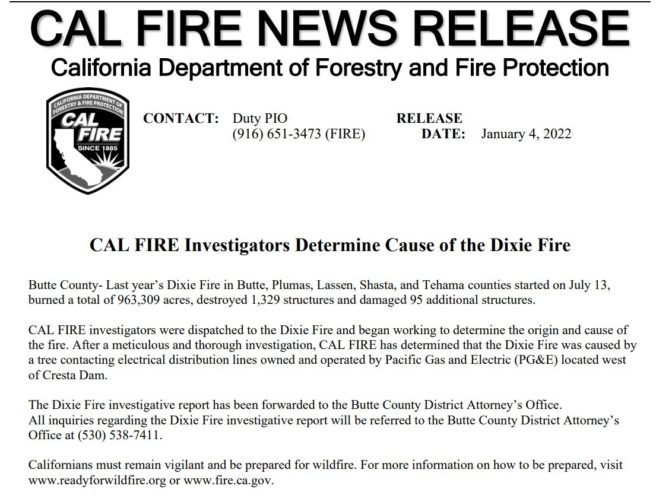
Cal Fire Announces that PG&E’s Facilities Sparked Dixie Fire

After a “meticulous and thorough investigation,” Cal Fire concludes that the Dixie Fire was caused by a tree contacting PG&E’s electrical lines.

No surprise, given that PG&E all but admitted as much last July.

We can expect Cal Fire to now join the lawsuit we’ve filed on behalf of our Dixie clients, seeking to recover from PG&E its costs of fire suppression.