Jack Daniels v. Bad Spaniels: Parody and First Amendment Protections Do Not Shield Users of Expressive Commercial Source-Identifying Marks From Trademark Infringement Liability

Seeing an opportunity to capitalize on comedic freedom of speech and parodistic liberties (think Weird Al Yankovic and Aqua’s Barbie Girl hit song), a pet toy maker decided to create a chewable, squeaky dog toy shaped like the famous bottle of Jack Daniel’s whiskey called “Bad Spaniels.” Instead of the recognizable slogan “Old No. 7 Brand Tennessee Sour Mash Whiskey” found on Jack Daniel’s products, Bad Spaniels featured the phrase “The Old No. 2 On Your Tennessee Carpet.” Jack Daniel’s was not impressed and forced a lawsuit to determine whether its registered trademarks in the Jack Daniel’s name, words and graphics on its labels, and bottle trade dress were infringed by Bad Spaniels.

At the trial court level, Jack Daniel’s argued Bad Spaniels infringed Jack Daniel’s famous marks because consumers were led to believe that Jack Daniel’s had created or sponsored the dog toy. Jack Daniel’s further accused Bad Spaniels of diluting its marks by associating the famed whiskey with dog excrement. Relying on the Rogers Test[1] for expressive artistic works adopted by the Second Circuit, Bad Spaniels argued its use of the Jack Daniel’s signature marks had artistic relevance to its toy products and the dog toys did not explicitly mislead consumers as to source of the goods. The District Court sided with Jack Daniel’s finding the Rogers Test inapplicable because Bad Spaniels was using the allegedly infringing marks as trademarks, and therefore, liability turned on a likelihood of confusion analysis, which the court found tipped in Jack Daniel’s favor. Bad Spaniels appealed and the Ninth Circuit reversed. Latching on to the “humorous message” communicated by the dog toys and Bad Spaniels’ efforts to parody Jack Daniel’s, the appellate court determined that Bad Spaniels’ First Amendment freedom of expression trumped Jack Daniel’s claim of consumer confusion. The Ninth Circuit also found Bad Spaniel’s use of the Jack Daniel’s marks to be “non-commercial” and exempt from dilution claims per 15 U. S. C. § 1125(c)(3)(C). The Supreme Court rejected the Ninth Circuit’s conclusions, holding instead that when an accused infringer uses another’s trademark (or a substantially/confusingly similar mark) as a trademark to designate the source of its own goods, the First Amendment does not preclude a likelihood of confusion analysis regardless of the artistic merit of the allegedly infringing use. See Jack Daniel’s Props. v. VIP Prods. LLC, 2023 U.S. LEXIS 2422 (2023). Moreover, the Supreme Court revived Jack Daniel’s dilution claim finding the use of a mark does not count as noncommercial just because it parodies, or otherwise comments on, another’s products.

In analyzing the issue, the Supreme Court started with the fundamentals of trademark law: a trademark is “any word, name, symbol, or device, or any combination thereof” that distinguishes the source of the goods or services provided under that mark from those manufactured or sold by others. 15 U. S. C. § 1127. At their core, trademarks serve as source indicators and identifiers to allow consumers to discern and differentiate between products and services offered by different providers. In that way, brands derive substantial value from their marks, which consumers recognize and come to associate with a certain level of quality, consistency, and source, e.g. Nike “swoosh” on sneakers, Apple “bitten apple” on electronics, Starbuck’s “siren” on coffee cups, etc. Owners of registered and unregistered trademarks enjoy the protections of the Lanham Act, which imposes infringement liability for unauthorized use of a similar mark “likely to cause confusion, or to cause mistake, or to deceive” as to “the source of a product or service.” 15 U. S. C. §§ 1114(1)(A), 1125(a)(1)(A). Additionally, the Lanham Act provides a cause of action for dilution of famous marks, which occurs when a similar mark is used in such a way as to damage or dimmish the public’s perception of the famous mark. 15 U. S. C. § 1125(c)(2)(A). For example, selling cheap clothes labeled FERRARI, opening a strip club under the name CHIK-FIL-A, or offering GUCCI burgers and fries. There are of course several exclusions: “noncommercial use of a mark” does not give rise to a dilution claim; and when a mark is used “in connection with . . . parodying, criticizing, or commenting upon the famous mark owner or [its] goods” it is subject to a “fair use” defense (news reporting, articles, education materials, satire, etc.), except when the famous mark or a similar mark is used as a source-identifying trademark. 15 U. S. C. §§ 1125(c)(3)(A), 1125(c)(3)(C).

Jack Daniel’s has amassed several distinctive registered marks: the “Jack Daniel’s” name, “Old No. 7,” the Jack Daniel’s logo, the stylized black label with white twirling lines, and the square bottle. Bad Spaniel’s squeaky dog toy incorporates modified versions of these elements made to resemble and evoke an image of a Jack Daniel’s bottle of whiskey.
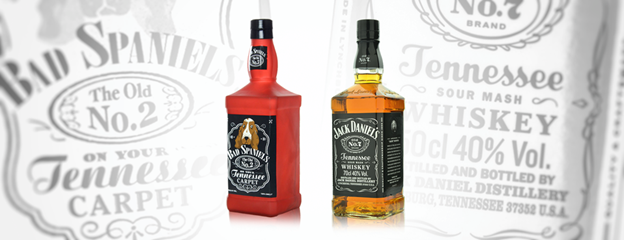
bad spaniels and jack daniels lawsuit

Thus, because Bad Spaniel used the parody marks as source identifiers, i.e., to distinguish the source of its dog toys from that of other toys, the dispositive legal question was a likelihood-of-confusion analysis, i.e., whether consumers would be confused into thinking Bad Spaniels was associated with, sponsored by, or produced by Jack Daniel’s. The Supreme Court parted ways with the Ninth Circuit in rejecting the notion that because a trademark may have expressive value, i.e., it conveys some type of message or commentary in addition to source, it is entitled to First Amendment protection and insulation from infringement liability. Most trademarks and trade dresses convey a message or contain some expressive value, and therefore the exception (Rogers test) would swallow the rule (protection from consumer confusion). And therefore, the Supreme Court remanded the case for a likelihood-of-confusion determination, which would entail a consideration of whether Bad Spaniel’s parodic message creates enough of a contrast with the original such that its message of ridicule or pointed humor comes clear and would not lead to consumer confusion.

________________

[1] The Rogers test requires dismissal of an infringement claim unless the complainant can show one of two things: that the challenged use of a mark “has no artistic relevance to the underlying work” or that it “explicitly misleads as to the source or the content of the work.” Rogers v. Grimaldi, 875 F. 2d 994, 999 (CA2 1989) (Newman, J.).

The post Jack Daniels v. Bad Spaniels: Parody and First Amendment Protections Do Not Shield Users of Expressive Commercial Source-Identifying Marks From Trademark Infringement Liability appeared first on Stark & Stark, PC.

Injury v. Discovery: When Copyright Holders Can Recover Damages for Infringement that Occurred More than Three Years Before Discovery of the Infringement

Since the Supreme Court’s decision in Petrella v. Metro-Goldwyn-Mayer, 572 U.S. 663 (2014) allowing copyright plaintiffs to recover for damages incurred during a three-year look-back period even when suit is filed many years after the initial infringement occurred, defendants have argued that plaintiffs’ recoverable damages are limited to those sustained in the three years preceding the lawsuit regardless of when filed or when the infringement was discovered. This means that a plaintiff that did not discover or have reason to know of the infringement when it first occurred would be barred from recovering damages for that infringement if suit is filed more than three years after the unknown infringement started.

Recently, several circuit appeals courts confronted with these fact patterns affirmed the existence and application of the discovery rule and its distinction from the injury rule espoused by Petrella. Under the discovery rule, the three-year damages bar contained in Section 507(b) of the Copyright Act does not apply when a plaintiff was reasonably unaware of past infringements and filed suit within three years of discovery. Thus, if suit is filed within three years of “discovery,” a plaintiff will be entitled to seek damages for all periods of infringement, including those that occurred more than three years prior to the filing of the suit; but if after discovery of infringement, which continues, a plaintiff waits more than three years to file suit (based on “injury” that occurred from infringements during the three years leading up to the lawsuit), its damages will be limited to the three year period preceding the filing of the lawsuit.

In Starz Ent., LLC v. MGM Domestic Television Distrib., LLC, 39 F.4th 1236, 1242-44 (9th Cir. 2022), Starz Entertainment sued MGM for copyright infringement arising from MGM’s licensing of movies and television shows to third-parties in breach of the exclusive rights Starz received from MGM many years earlier in exchange for $70 million payment. Starz brought its lawsuit within three years after discovering MGM’s transgressions and MGM sought to bar Starz from recovering any damages for infringement that occurred more than three years prior to the filing of the suit.  The district and appellate courts rejected that limitation holding that § 507(b) does not prohibit the recovery of damages for infringing acts that occurred outside the three-year look-back period so long as “the copyright plaintiff was unaware of the infringement, and that lack of knowledge was reasonable under the circumstances.”

17 U.S.C. § 507 establishes the statute of limitations under the Copyright Act: “No civil action shall be maintained under the provisions of this title unless it is commenced within three years after the claim accrued.” In the copyright context, a claim accrues “when an infringing act occurs,” Petrella, 572 U.S. at 670, i.e., when the infringer “violates any of the exclusive rights of the copyright owner,” Bell v. Wilmott Storage Servs., LLC, 12 F.4th 1065, 1080 (9th Cir. 2021) (emphasis omitted) (quoting 17 U.S.C. § 501(a)), although this is not the only time a claim accrues. In the case of continuing infringement, which became known to or reasonably should have been discovered by the rights holder, a plaintiff can file suit any time within three years of an infringing event, however, if suit is brought more than three years after initial discovery, recovery would only be allowable for infringing acts occurring within the three-year window before the filing of the lawsuit.

The overwhelming majority of courts agree that when suit is filed within three years of initial discovery, a plaintiff can recover damages for infringing acts that occurred more than three years prior without limitation. See 6 William F. Patry, Patry on Copyright § 20:19 (2013) (collecting cases). The exception being the Second Circuit. In Sohm v. Scholastic Inc., 959 F.3d 39 (2d Cir. 2020), the Second Circuit held that the Petrella Court “explicitly delimited damages to the three years prior to the commencement of a copyright infringement action.” Therefore, it concluded that the discovery rule applies to determine when a copyright infringement claim accrues, but a three-year lookback period from the time a suit is filed applies to determine the extent of the relief available. Accordingly, the Sohm court limited a plaintiff’s recoverable damages to infringement occurring during the three years prior to filing suit, even where the copyright holder was unaware of prior infringing acts.

Latching on to that philosophy, MGM argued Starz’s damages were limited to those suffered in the three years prior to suit regardless of when it discovered the infringement. The Ninth Circuit, however, diverged from the Second Circuit in finding that Petrella did not dictate a limitation on damages rule. Instead, the appellate court reasoned that the discovery rule allowed copyright holders to recover damages for all infringing acts that occurred before they knew or reasonably should have known of the infringing incidents. Otherwise, if claimants were automatically limited to only recovering for acts occurring a few years before an infringement claim accrued, the discovery rule would serve no purpose, an absurd result.

For litigants in cases involving long term infringement, the battle ground will surround when a plaintiff “should” have discovered the infringement through the exercise of “reasonable diligence.”

The post Injury v. Discovery: When Copyright Holders Can Recover Damages for Infringement that Occurred More than Three Years Before Discovery of the Infringement appeared first on Stark & Stark.

The Cannabis Paradox: Clarifying the Confusing Legality of Delta-8, THC-O, THCV, and Synthetically Derived THC

Both marijuana and hemp belong to the genus plant cannabis sativa and are slightly different “breeds” of the same “species.” While both marijuana and hemp plants contain more than 100 cannabinoids (distinct chemicals found in the cannabis plant), the discerning difference between the two is that marijuana typically has abundant levels of the psychoactive compound delta-9 THC (delta-9-tetrahydrocannabinol), whereas hemp contains high amounts of CBD (cannabidiol). Prior to 2019, both marijuana and hemp were lumped together as “marihuana/marijuana” and classified as a federally prohibited Schedule 1 drug under the Controlled Substances Act (“CSA”).

That changed with the passage of the 2018 Agricultural Improvement Act (the “Farm Bill”), which effectively removed “hemp” from the definition of “marijuana” in the CSA. The Farm Bill defined “hemp” as “the plant Cannabis sativa L. and any part of that plant, including the seeds thereof and all derivatives, extracts, cannabinoids, isomers, acids, salts, and salts of isomers, whether growing or not, with a delta-9 [THC] concentration of not more than 0.3 percent on a dry weight basis.” See 7 U.S.C. § 1639o(1). Therefore, the difference between federally-illegal marijuana and federally-legal hemp is the THC content, with the threshold divider being 0.3% THC potency. Thus, while Schedule 1 prohibits “tetrahydrocannabinols [THC],” it provides an exception for “tetrahydrocannabinols in hemp.” See 21 U.S.C. § 812 sched. I(c)(17). Furthermore, the DEA has recognized that “any material, compound, mixture, or preparation that falls within the definition of hemp set forth in 7 U.S.C. [§] 1639o” is exempt from federal prohibition. See 21 C.F.R. § 1308.11(d)(31)(ii); see also 21 C.F.R. § 1308.11(d)(58) (defining “Marihuana Extract” to include only cannabinoid extracts with greater than 0.3 percent delta-9 THC).

Simply put, any extracts or derivatives derived from hemp that contain no more than 0.3% delta-9 THC are federally permissible. Enter delta-8 THC. Delta-8 THC is one of the cannabinoids naturally occurring in the cannabis plant but is not found in significant amounts; it can nevertheless be manufactured in concentrated amounts from CBD. CBD can be converted to delta-8 in a lab through a relatively simple isomerization process involving reacting CBD with solvent-acid solutions at high heat. Despite the simplicity (or as a result of), not all delta-8 THC is equal, and attention to solvents, acids, cleaning agents, and retention of residual chemicals is paramount in creating a clean, unadulterated product. Lack of regulation, oversight, and standards results in many finished delta-8 products containing potentially harmful chemicals such as acetic acid and residual metals. Moreover, it has been reported that many products sold as delta-8 do not actually contain pure delta-8 THC and are filled with various cannabinoids, such as delta-9 THC and delta-10 THC as well as “unknown” compounds (source).

Delta-8 is said to have a milder psychoactive “high” effect than delta-9, and some people report experiencing a euphoric feeling without the paranoia sometimes associated with delta-9 THC consumption. Others, especially those who consumed delta-8-infused edibles (gummies, brownies, beverages, etc.), reported heightened levels of anxiety, hallucinations, insomnia, confusion, dizziness, and generally unpleasant experiences.

Despite many unknowns and uncertainties about delta-8, it remains federally legal yet unregulated. Several courts confronted with the issue have confirmed that as long as a delta-8 product is derived from hemp and contains less than 0.3% delta-9 THC it is allowed per the Farm Bill. See AK Futures Ltd. Liab. Co. v. Boyd St. Distro, Ltd. Liab. Co., 35 F.4th 682, 695 (9th Cir. 2022) (finding plaintiff’s “delta-8 THC products are lawful under the plain text of the Farm Act and may receive trademark protection”); Ky. Hemp Ass’n v. Quarles, 2022 Ky. Cir. LEXIS 7, *25 (August 3, 2022) (concluding that “Delta-8 tetrahydrocannabinol, as a derivative of Hemp, and any products that contain Delta-8 tetrahydrocannabinol are legally compliant Hemp pursuant to KRS 260.850(5) and 7 U.S.C. 1639o(1) so long as the same contain a delta-9 tetrahydrocannabinol concentration of not more than 0.3 percent on a dry weight basis”).

Now the paradox: delta-9 THC remains federally illegal as many states continue instituting laws to legalize and regulate medicinal and recreational marijuana products; and while delta-8 THC is federally legal, many states are enacting laws and regulations prohibiting and restricting the manufacture, sale, and use of delta-8 products. Some prominent states to ban delta-8 include Arizona, Colorado, Nevada, New York, Oregon, and Washington. Other states like Virginia and Michigan decided to regulate delta-8 like marijuana and require producers obtain a state license before being allowed to produce and sell delta-8 products.

Recently, other hemp-derived isolates and derivatives, such as delta-9 THC, THC-O acetate, and THCV, have been hitting the market. Astute cannabis entrepreneurs have figured out how to exploit the less than 0.3 percent THC loophole to legally produce and sell delta-9 THC-infused products. The Farm Bill authorizes hemp-derived products containing less than 0.3% THC on a dry weight basis, which means for edible and gummy products, up to 0.3% of the product’s dry weight can consist of THC. For example, a bag of gummies that weighs 110 grams can legally contain 100 mg of THC (think 20 gummies containing 5 mg of THC per serving). And thus, the influx of delta-9 THC edible products available for purchase at gas stations, kiosks, and e-commerce websites.

THCV (delta-9 tetrahydrocannabivarin) is still being studied, but early reports suggest it may reduce appetite, suppress nausea and anxiety, and increase alertness. Moreover, THCV has been reported to reduce negative effects associated with THC, such as increased heart rate, paranoia, and verbal recall issues. Compared to THC, THCV imparts less of a psychoactive effect on the user and moderates the intoxicating effect of delta-9 or delta-8 when used together.

THC-0, an ester of THC, is synthesized from delta-8 THC using acetic anhydride, a volatile and flammable chemical, and is said to be three times as potent as THC. Very little is known about how THC-O consumption affects the body across various modalities and whether it poses any long-term risks.

While naturally occurring cannabinoids (biologically existing in the cannabis plant) such as THC and THCV are federally permissible if derived from hempthe DEA has recently declared synthetic isomers delta-8-THCO (delta-8-THC acetate ester) and delta-9-THC-O (delta-9-THC acetate ester) federally prohibited substances irrespective of whether they come from hemp. The DEA determined that because THC-O does not occur naturally in the cannabis plant and can only be created synthetically, it does not fall under the definition of hemp and is a non-exempt synthetic tetrahydrocannabinol prohibited by Schedule I. 21 U.S.C. § 812, Schedule I(c)(17); 21 CFR 1308.11(d)(31). To say cannabis legality is a grey area would be an understatement. One thing is certain – the industry and consumers would indelibly benefit from federal regulation, standardization, and testing criteria to bring uniformity, consistency, and reliability to an evolving market while reducing risks and hazards inherent in the unregulated unknown.

The post The Cannabis Paradox: Clarifying the Confusing Legality of Delta-8, THC-O, THCV, and Synthetically Derived THC appeared first on Stark & Stark.